
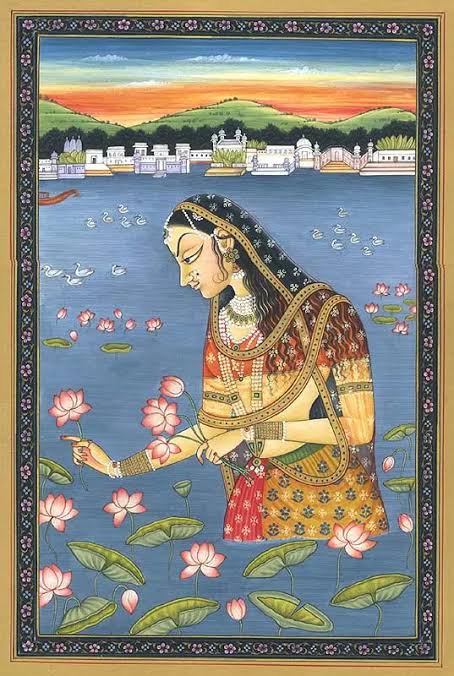
📍 Region & Centre
Developed in Kishangarh (near Ajmer), Rajasthan
Originally part of the Marwar tradition, but evolved into a distinct school
🕰️ Historical Background
Flourished in the 18th century
Reached its peak during the reign of Raja Sawant Singh (1748–1757)
Strong influence of Vaishnav Bhakti movement
🖌️ Patronage & Artists
Chief patron: Raja Sawant Singh (poet–king, pen name Nagari Das)
Chief painter: Nihal Chand
Paintings reflect deep romantic and devotional sensibility
🎨 Main Characteristics (Style & Features)
🔹 Facial Features (Most Distinctive)
Elongated face
Arched eyebrows
Lotus-shaped, half-closed eyes
Sharp pointed nose
Thin lips and slender neck 👉 These features define the iconic Bani Thani style
🔹 Colour Scheme
Soft, lyrical colours
Use of:
Blue
Green
Pink
Golden hues
Delicate shading
🔹 Themes & Subjects
Radha–Krishna love (central theme)
Bhakti and Shringara rasa
Portraits of:
Raja Sawant Singh (as Krishna)
Bani Thani (as Radha)
Ragamala paintings
🔹 Background & Composition
Stylized landscapes
Flowing rivers, gardens, moonlit nights
Emphasis on emotion over realism
🖼️ Bani Thani Painting
Considered the “Mona Lisa of India”
Represents:
Ideal feminine beauty
Spiritualized love
Now preserved in the National Museum, Delhi
✨ Importance of Kishangarh School
Most romantic and poetic school of Rajasthani painting
Unique for its:
Stylized beauty
Emotional depth
Major contribution to Indian miniature art


