
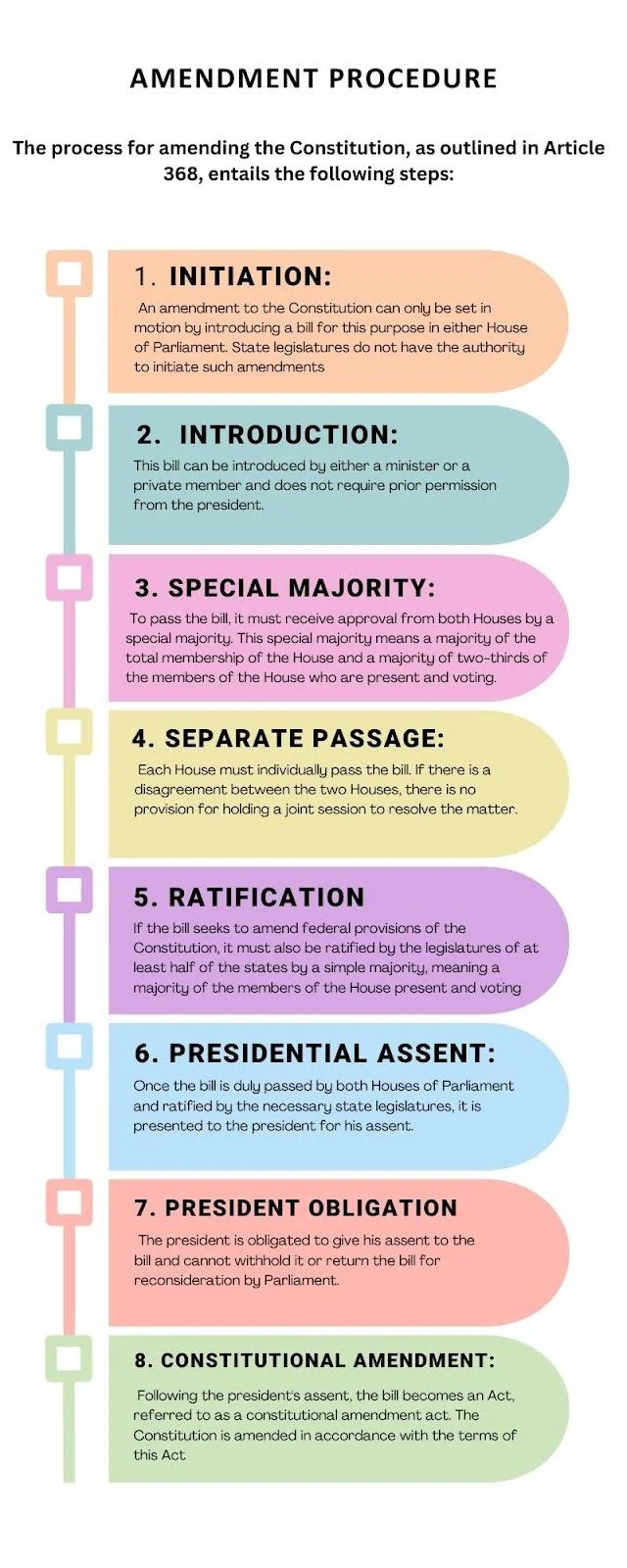
An amendment is a formal change or addition made to the Constitution to meet changing social, political, and economic needs. The power to amend the Constitution lies with Parliament under Article 368.
Need for Constitutional Amendments
To adapt to changing times
To correct lacunae and contradictions
To ensure social justice and reforms
To strengthen democratic governance
Procedure of Amendment (Article 368)
1. Simple Majority
Passed like an ordinary law
No special procedure
Example:
Creation of new states
Changes in salaries of judges
2. Special Majority
Majority of total membership of Parliament
And 2/3rd of members present and voting
Example:
Fundamental Rights
DPSPs
3. Special Majority + State Ratification
Special majority in Parliament
Ratification by at least half of the State Legislatures
Example:
Federal provisions
Election of President
Centre–State relations
Important Constitutional Amendments
1. 1st Amendment (1951)
Reasonable restrictions on Fundamental Rights
Protection of land reform laws
2. 24th Amendment (1971)
Parliament’s power to amend any part of Constitution
Made Article 368 supreme
3. 42nd Amendment (1976) – “Mini Constitution”
Added:
Socialist, Secular to Preamble
Fundamental Duties
Strengthened Centre
4. 44th Amendment (1978)
Restored democratic safeguards
Right to Property removed from FR (now Article 300A)
5. 52nd Amendment (1985)
Anti-Defection Law
6. 73rd & 74th Amendments (1992)
Panchayati Raj & Urban Local Bodies
7. 86th Amendment (2002)
Right to Education (Article 21A)
8. 101st Amendment (2016)
Goods and Services Tax (GST)
9. 103rd Amendment (2019)
10% EWS reservation
Limitations on Amendment Power
Basic Structure Doctrine
Established in Kesavananda Bharati Case (1973)
Parliament cannot amend:
Supremacy of Constitution
Fundamental Rights
Federalism
Judicial review
Secularism
Significance
Makes Constitution flexible yet rigid
Balances continuity with change
Strengthens democratic framework


