
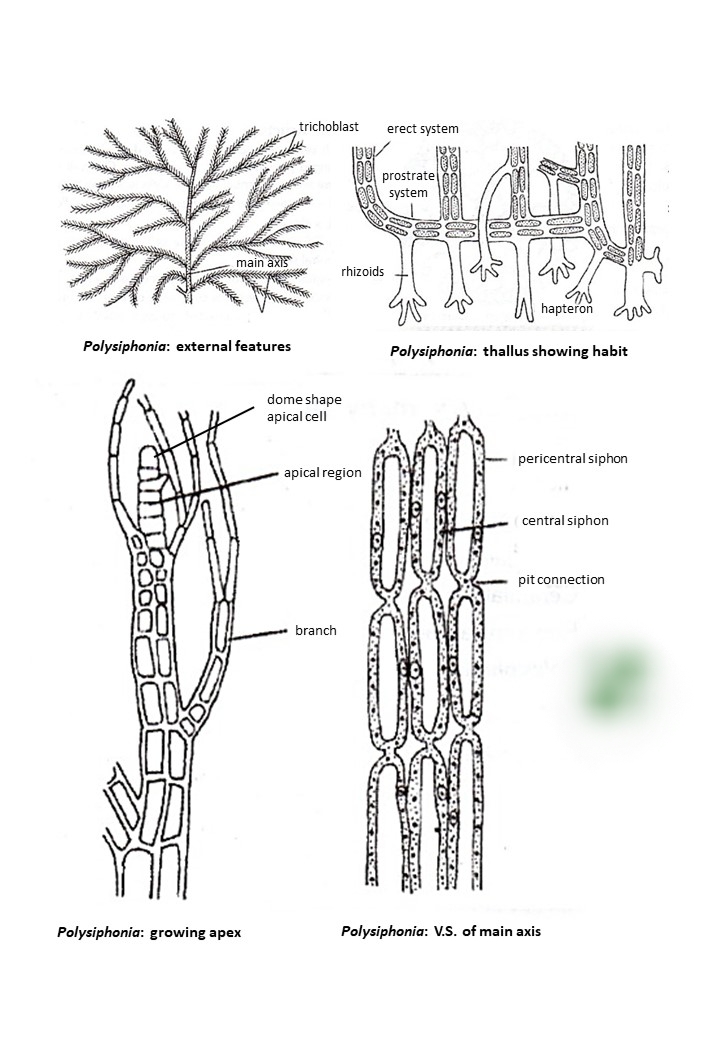
1️⃣ Systematic Position (Classification)
Kingdom: Plantae
Division: Rhodophyta (Red algae)
Class: Rhodophyceae
Order: Ceramiales
Genus: Polysiphonia
2️⃣ Habitat
Marine alga
Found attached to rocks and other seaweeds
Common in coastal regions
Prefers shallow waters
3️⃣ Thallus Organisation (External Morphology)
Multicellular, filamentous red alga
Thallus is delicate and branched
Branching is dichotomous or alternate
Thallus shows polysiphonous organisation
📌 Polysiphonous condition is the most important identifying feature
4️⃣ Polysiphonous Condition
Central axial cell present
Surrounded by many pericentral cells
Number of pericentral cells is constant for species
Gives strength and flexibility to thallus
5️⃣ Cell Structure
Cell wall made of:
Cellulose
Pectic substances
Pigments:
Chlorophyll a
Phycoerythrin (red colour)
Phycocyanin
Reserve food:
Floridean starch
No flagellated cells at any stage
6️⃣ Nutrition
Autotrophic
Photosynthesis
Adapted to deeper marine waters due to red pigment
7️⃣ Reproduction in Polysiphonia
🔹 A. Vegetative Reproduction
By fragmentation
Detached fragments develop into new plants
🔹 B. Asexual Reproduction
By tetraspores
Tetraspores are:
Haploid
Non-motile
Formed inside tetrasporangia
Tetraspores germinate into new plants
🔹 C. Sexual Reproduction
Type: Oogamy
Plants are dioecious
Male Reproductive Organ:
Spermatangium
Produces non-motile spermatia
Female Reproductive Organ:
Carpogonium
Flask-shaped
Possesses a long trichogyne
➡️ Fertilization occurs when spermatium fuses with carpogonium
8️⃣ Post-Fertilization Changes
Formation of carposporophyte
Carposporophyte remains attached to female plant
Produces carpospores


