
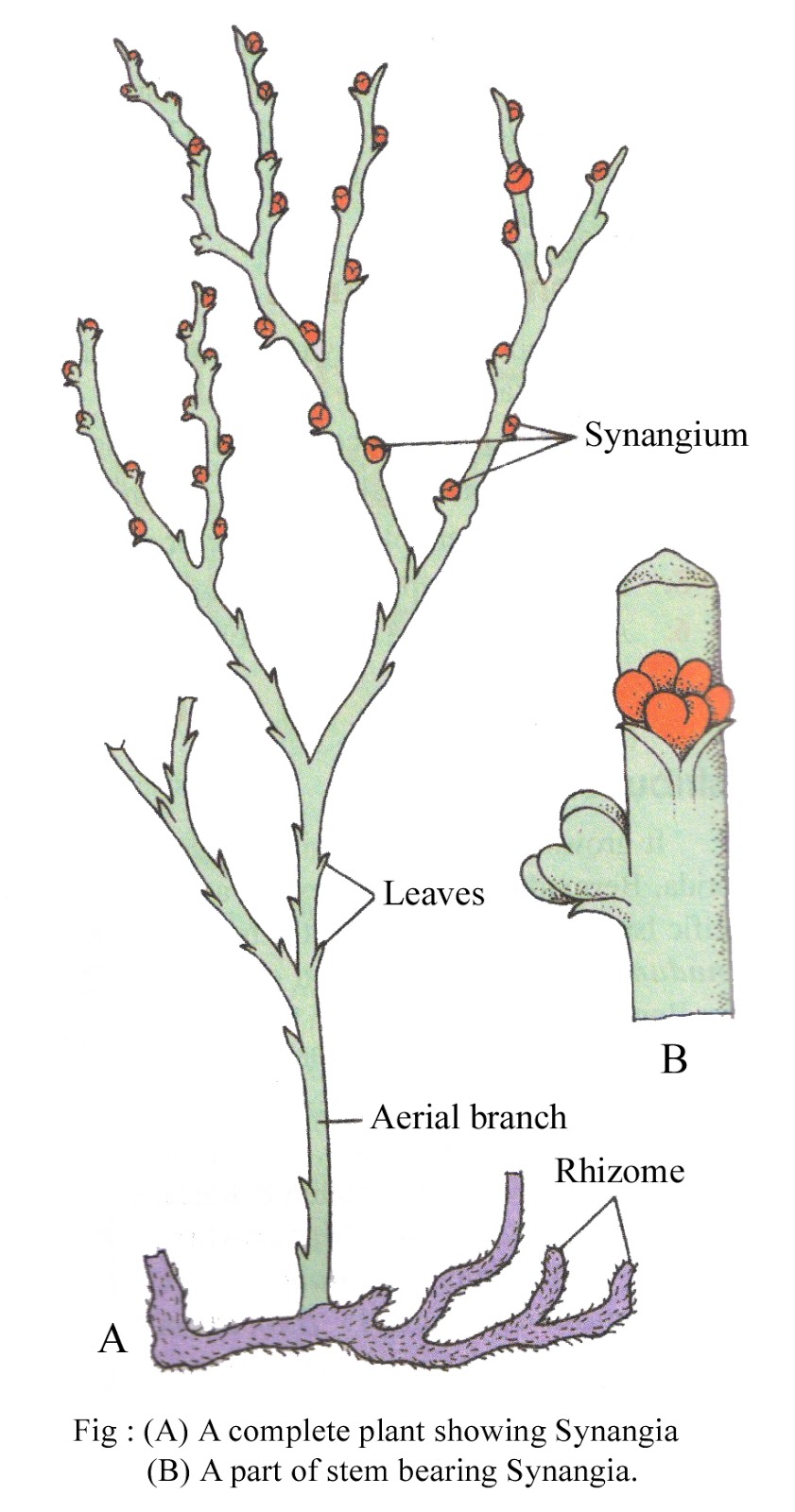
Psilotum is a primitive living pteridophyte, often called a living fossil. It shows many simple, early vascular plant characters.
1️⃣ Systematic Position
Kingdom: Plantae
Division: Pteridophyta
Class: Psilopsida
Order: Psilophytales
Family: Psilotaceae
Genus: Psilotum
2️⃣ Habit & Habitat
Small, perennial herb
Grows in tropical and subtropical regions
Usually epiphytic or grows on moist rocky soils
Common species: Psilotum nudum
3️⃣ Sporophyte Structure
(a) Root
True roots absent
Instead, a rhizome is present
Rhizome bears rhizoids
Mycorrhizal association helps in absorption
(b) Stem
Aerial stem is green, photosynthetic
Dichotomous branching
No differentiation into nodes and internodes
Covered by small scale-like outgrowths (enations)
(c) Leaves
True leaves absent
Small, leaf-like structures called enations
Enations lack vascular tissue
4️⃣ Internal Structure (Anatomy)
(a) Stem Anatomy
Epidermis with cuticle and stomata
Cortex: parenchymatous
Stele: Protostele
Xylem exarch
Phloem surrounds xylem
5️⃣ Reproduction
(a) Vegetative Reproduction
By fragmentation of rhizome
(b) Asexual Reproduction (Sporangia)
Occurs by spores
Sporangia are fused in groups of three, forming a synangium
Synangium is borne laterally on the aerial stem
Each sporangium produces numerous spores
Spores are homosporous
(c) Sexual Reproduction
Spores germinate to form gametophyte
Gametophyte is:
Subterranean
Non-green
Mycorrhizal
Bisexual (antheridia and archegonia both present)
6️⃣ Fertilization
Requires water
Motile, multiciliate sperm swims to egg
Zygote develops into a new sporophyte
7️⃣ Life Cycle
Shows alternation of generations
Dominant phase: Sporophyte
Gametophyte is independent but underground
8️⃣ Primitive Characters
Absence of roots and leaves
Dichotomous branching
Simple vascular tissue
Synangium formation
Resembles early vascular plants (Rhynia)
9️⃣ Economic Importance
Of evolutionary significance
Used in botanical research
Sometimes grown as an ornamental


