
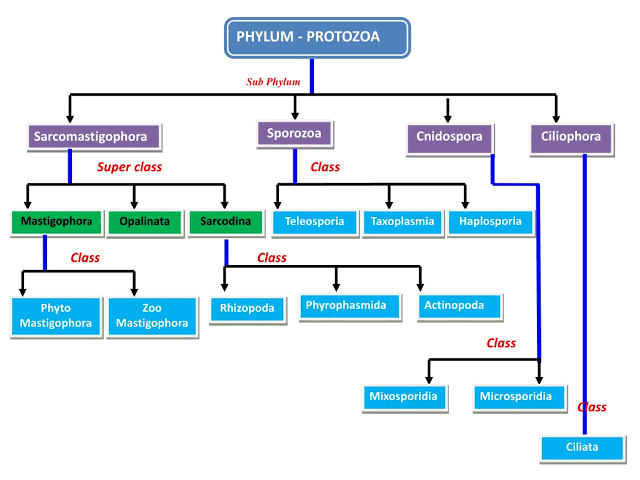
Class I – Sarcodina (Rhizopoda)
Key Features
Locomotion by pseudopodia
Body naked or with shell (test)
Nutrition: Holozoic
Reproduction: Binary fission
Examples
Amoeba proteus
Entamoeba histolytica
Important Study: Amoeba
Shape: Irregular
Pseudopodia used for movement & food capture
Contractile vacuole for osmoregulation
Entamoeba histolytica causes amoebic dysentery
Class II – Mastigophora (Flagellata)
Key Features
Locomotion by flagella
One or more flagella present
Many are parasitic
Nutrition: Autotrophic or heterotrophic
Examples
Euglena
Trypanosoma
Leishmania
Important Study: Euglena
Shows mixotrophic nutrition
Chloroplast present
Pellicle instead of cell wall
Eyespot for photoreception
⚠️ Trypanosoma causes sleeping sickness
Class III – Sporozoa (Apicomplexa)
Key Features
Endoparasitic
No locomotory organ
Complex life cycle
Spore formation present
Example
Plasmodium (malarial parasite)
Life Cycle of Plasmodium
Two hosts:
Human (asexual cycle)
Female Anopheles mosquito (sexual cycle)
Diseases
Causes malaria
Symptoms: Fever, chills, anemia
📝 Exam favorite topic ⭐
Class IV – Ciliata (Ciliophora)
Key Features
Locomotion by cilia
Two nuclei:
Macronucleus (metabolic)
Micronucleus (reproductive)
Most advanced protozoa
Examples
Paramecium
Vorticella
Important Study: Paramecium
Slipper-shaped body
Oral groove for feeding
Contractile vacuoles at both ends
Reproduction by:
Binary fission
Conjugation (sexual)


