
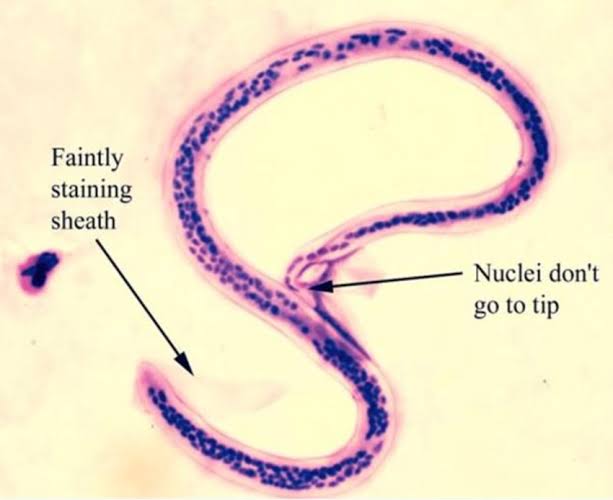
🔹 Classification
Phylum: Nematoda
Genus: Wuchereria
Species: bancrofti
🔹 Habitat
Endoparasite
Adult worms live in lymphatic vessels and lymph nodes of humans
Larval stage (microfilaria) circulates in blood
🔹 External Morphology
Body is long, slender, cylindrical
Covered with smooth cuticle
Sexes are separate (dioecious)
Sexual dimorphism:
Female: Longer and thicker
Male: Smaller, posterior end curved
🔹 Level of Organization
Organ-system level organization
🔹 Symmetry
Bilateral symmetry
🔹 Germ Layers
Triploblastic
🔹 Body Cavity
Pseudocoelomate
🔹 Digestive System
Complete
Mouth → pharynx → intestine → anus
🔹 Respiration
Absent
Exchange of gases by diffusion
🔹 Circulatory System
Absent
🔹 Excretory System
Renette cells
Excretory pore present
🔹 Nervous System
Nerve ring around pharynx
Longitudinal nerve cords
🔹 Reproduction
Sexual reproduction
Fertilization is internal
Female produces microfilariae instead of eggs
🔹 Life Cycle (Indirect) ⭐
Primary host: Human
Intermediate host / Vector: Female Culex mosquito
Stages:
Adult worms in human lymph vessels
Microfilariae released into blood
Mosquito sucks infected blood
Microfilariae develop into infective larvae inside mosquito
Larvae enter new human host during mosquito bite
Larvae reach lymphatic system and mature
🔹 Disease Caused
Filariasis (Elephantiasis)
Symptoms:
Swelling of legs, arms, breasts, or genitals
Thickened skin
Blockage of lymph vessels
🔹 Prevention and Control
Mosquito control
Use of bed nets
Proper sanitation
Mass drug administration programs


