
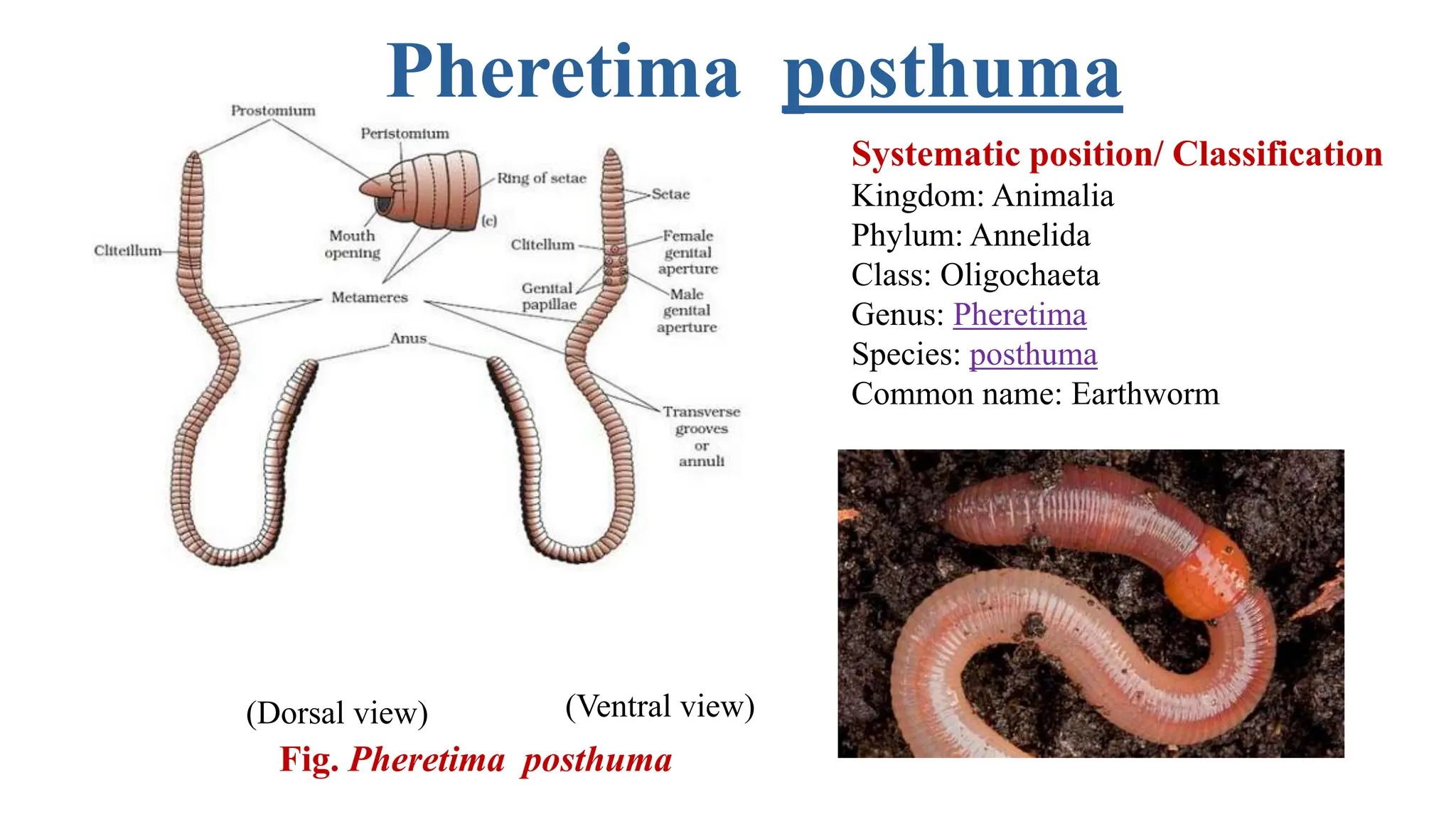
1. Systematic Position
Phylum: Annelida
Class: Oligochaeta
Order: Haplotaxida
Genus: Pheretima
Species: posthuma
2. Habit and Habitat
Terrestrial, burrowing annelid
Found in moist, humus-rich soil
Nocturnal in habit
Feeds on decaying organic matter
3. External Morphology
Body Shape and Size
Body elongated, cylindrical, and metamerically segmented
Length: 15–25 cm
Colour: Brownish
About 100–120 segments
Body Regions
Anterior end: Mouth present on peristomium
Posterior end: Anus on last segment
No distinct head
Setae
Small, S-shaped setae present in all segments except first, last, and clitellar segments
Help in locomotion
Clitellum
Glandular, saddle-shaped band
Present on segments 14–16
Secretes cocoon during reproduction
4. Body Wall
Thin cuticle
Epidermis with mucus glands
Muscular layers:
Circular muscles
Longitudinal muscles
5. Coelom
True, spacious coelom
Divided by septa
Acts as hydrostatic skeleton
6. Digestive System
Complete and straight
Parts:
Mouth
Buccal cavity
Pharynx
Oesophagus
Gizzard (grinding food)
Intestine (with typhlosole)
Anus
Feeding habit:
Detritivorous
Typhlosole increases absorptive surface
7. Circulatory System
Closed circulatory system
Blood vessels:
Dorsal vessel
Ventral vessel
Lateral hearts (4 pairs)
Blood pigment:
Haemoglobin dissolved in plasma
8. Respiratory System
Respiration through moist skin
No specialized respiratory organs
9. Excretory System
Excretion by nephridia
Types:
Pharyngeal nephridia
Septal nephridia
Integumentary nephridia
Functions in excretion and osmoregulation
10. Nervous System
Well developed
Components:
Pair of cerebral ganglia (brain)
Circum-pharyngeal connectives
Double ventral nerve cord
Sense organs:
Tactile receptors
Chemoreceptors
Photoreceptors
11. Reproductive System
Hermaphrodite
Cross-fertilization
Male organs:
Testes, seminal vesicles
Female organs:
Ovaries, oviducts
Clitellum forms cocoon
12. Fertilization and Development
Fertilization occurs inside cocoon
Direct development
Young worm emerges from cocoon
13. Locomotion
By:
Alternate contraction of circular and longitudinal muscles
Setae
14. Economic Importance
Improves soil fertility
Aerates soil
Used in vermicomposting
15. Distinctive Features of Pheretima posthuma
Terrestrial oligochaete
Setae present, parapodia absent
Clitellum present
Closed circulatory system
Hermaphrodite


