
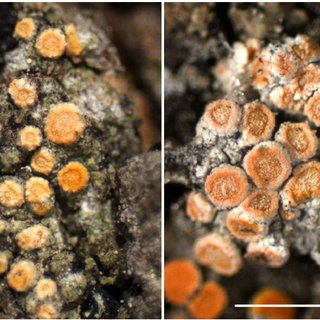
1. Systematic Position (Classification)
Kingdom: Fungi
Division: Ascomycota
Class: Lecanoromycetes
Order: Teloschistales
Family: Teloschistaceae
Genus: Caloplaca
2. General Introduction
Caloplaca is a crustose lichen well known for its bright orange, yellow, or reddish thallus and apothecia.
The name Caloplaca means “beautiful patches”, reflecting its striking colour.
It is a symbiotic association between:
Mycobiont: Ascomycete fungus
Phycobiont: Green alga (Trebouxia)
3. Habitat
Grows on rocks (saxicolous), walls, and tree bark
Common in sunny, dry, and exposed habitats
Widely distributed in temperate and tropical regions
4. Thallus Structure
Type: Crustose
Colour: Bright orange, yellow, or red (due to anthraquinone pigments)
Surface: Smooth, cracked, or areolate
Attachment: Firmly attached to substratum
Internal Structure
Upper Cortex
Compact fungal hyphae with pigments
Protects from strong sunlight
Algal Layer
Contains green algal cells (Trebouxia)
Photosynthetic zone
Medulla
Loosely arranged fungal hyphae
Lower Cortex
Absent
5. Reproduction
A. Vegetative Reproduction
By fragmentation of thallus
By soredia in some species
B. Asexual Reproduction
By conidia formed in pycnidia (rare)
C. Sexual Reproduction
Occurs through the fungal partner
Fruiting body is apothecium
Apothecium
Circular, disc-shaped
Often brightly coloured (same as thallus)
Contains asci and paraphyses
Asci
Usually bear 8 ascospores
6. Nutrition
Algal partner: Prepares food by photosynthesis
Fungal partner: Absorbs water, minerals, and provides protection
Association is mutualistic
7. Ecological and Economic Importance
Pioneer lichen on rocks and walls
Contributes to rock weathering and soil formation
Useful in air pollution studies
Adds colour to natural and urban landscapes
8. Diagnostic Features (Exam-Oriented)
Crustose lichen
Bright orange/yellow colour
Pigments → anthraquinones
Algal partner → Trebouxia
Fruiting body → apothecium


