
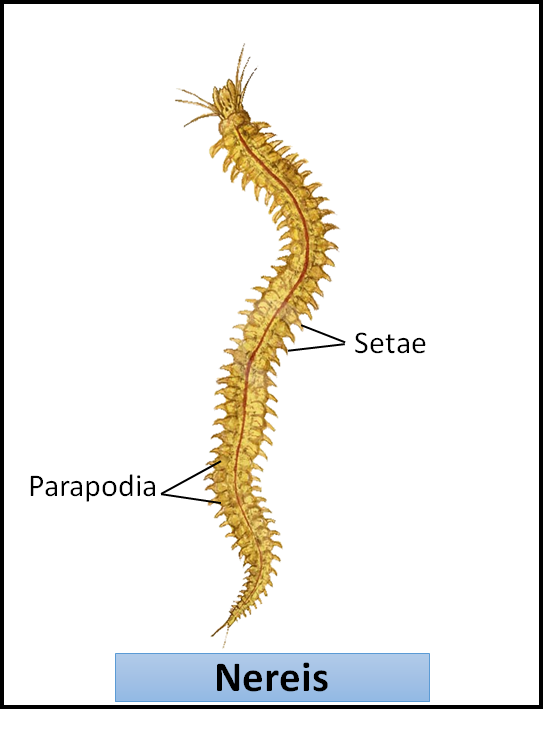
1. Systematic Position
Phylum: Annelida
Class: Polychaeta
Order: Errantia
Genus: Nereis
2. Habit and Habitat
Marine, free-living annelid
Found in sea shores, sandy and muddy burrows
Mostly nocturnal and carnivorous
3. External Morphology
Body Shape and Size
Body elongated, cylindrical, and metamerically segmented
Each segment similar except head and terminal region
Body Regions
Head
Formed by prostomium + peristomium
Prostomium bears:
Pair of antennae
Pair of palps
Four eyes
Peristomium bears mouth
Trunk
Composed of numerous similar segments
Each segment bears a pair of parapodia
Pygidium
Terminal segment
Bears anus and anal cirri
4. Parapodia
Paired, lateral, fleshy outgrowths
Each parapodium is biramous:
Notopodium (dorsal lobe)
Neuropodium (ventral lobe)
Bear numerous setae
Functions:
Locomotion
Respiration
5. Body Wall
Thin cuticle
Epidermis with gland cells
Muscular layers:
Circular muscles
Longitudinal muscles
6. Coelom
Well-developed true coelom
Divided by septa
Acts as hydrostatic skeleton
7. Digestive System
Complete and straight
Mouth → buccal cavity → pharynx → oesophagus → intestine → anus
Pharynx:
Muscular and eversible
Bears chitinous jaws
Feeding habit: Carnivorous
8. Circulatory System
Closed type
Blood vessels:
Dorsal blood vessel
Ventral blood vessel
Capillaries
Blood contains haemoglobin dissolved in plasma
9. Respiratory System
Respiration through:
Parapodia
General body surface
No specialized respiratory organs
10. Excretory System
Metanephridia
One pair in each segment
Remove nitrogenous wastes and regulate osmotic balance
11. Nervous System
Well developed
Consists of:
Paired cerebral ganglia (brain)
Circum-pharyngeal connectives
Double ventral nerve cord with segmental ganglia
Sensory organs:
Eyes
Antennae
Palps
12. Reproductive System
Dioecious (sexes separate)
Gonads develop temporarily
Fertilization:
External
Development:
Indirect
Larval stage: Trochophore larva
13. Epitoky (Heteronereis Stage)
Sexual reproduction involves transformation into Heteronereis
Body differentiates into:
Atoke (non-reproductive)
Epitoke (reproductive)
Epitoke swims to surface and releases gametes
14. Economic Importance
Used as fish bait
Important in marine food chains
Studied for evolutionary significance
15. Distinctive Features of Nereis
Marine polychaete
Biramous parapodia
Eversible pharynx with jaws
Trochophore larva
Heteronereis stage


