
🔹 Classification
Phylum: Platyhelminthes
Class: Turbellaria
Genus: Planaria
🔹 Habitat
Found in freshwater bodies like ponds, streams, and slow-moving water
Free-living; prefers moist, shady environments
🔹 External Morphology
Body is dorsoventrally flattened
Bilaterally symmetrical
Elongated, leaf-like body
Anterior end bears:
Two eye spots (ocelli) – light perception
Auricles – chemoreception
Body surface is ciliated and covered with mucus (helps in movement)
🔹 Level of Organization
Organ level organization
🔹 Germ Layers
Triploblastic (ectoderm, mesoderm, endoderm)
🔹 Body Cavity
Acoelomate
Space filled with parenchyma
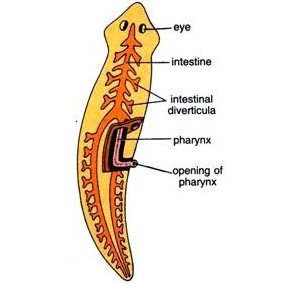
🔹 Digestive System
Incomplete
Mouth present on ventral side
Mouth leads to a muscular pharynx
Pharynx opens into a branched intestine
No anus; undigested food expelled through mouth
🔹 Nutrition
Carnivorous / scavenger
Feeds on small insects, worms, and organic debris
🔹 Respiration
Absent
Exchange of gases by diffusion through body surface
🔹 Circulatory System
Absent
Nutrients distributed by diffusion and branched gut
🔹 Excretory System
Flame cells (protonephridia)
Helps in excretion and osmoregulation
🔹 Nervous System
Ladder-like nervous system
Pair of anterior cerebral ganglia
Two longitudinal nerve cords with transverse connections
🔹 Locomotion
Gliding movement using:
Cilia
Muscular contractions
Mucus secretion
🔹 Reproduction
Asexual reproduction:
By transverse fission
Each fragment regenerates into a complete individual
Sexual reproduction:
Hermaphrodite
Cross-fertilization
Development is direct
🔹 Special Feature – Regeneration ⭐
Planaria has remarkable regenerative power
Even a small body fragment can regenerate into a complete organism
Due to presence of neoblast cells
🔹 Importance
Used in biological research for studying regeneration
Indicator of clean, oxygen-rich water


