
🔹 Classification
Phylum: Nematoda
Genus: Ascaris
Species: lumbricoides
🔹 Habitat
Endoparasite
Adult lives in the small intestine of humans
🔹 External Morphology
Body is long, cylindrical, and unsegmented
Tapering at both ends
Covered with a thick cuticle
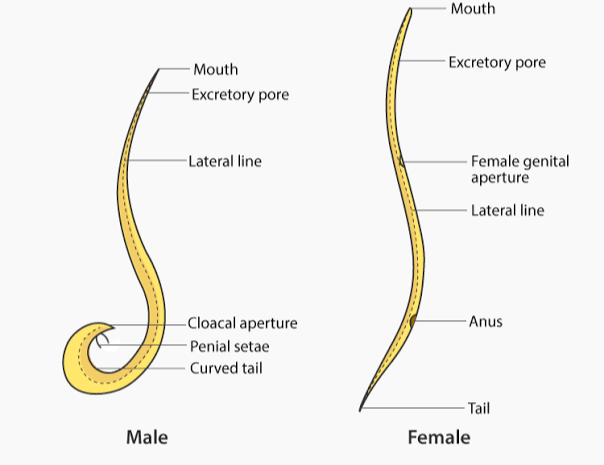
Sexual dimorphism:
Female: Larger (20–35 cm), straight posterior end
Male: Smaller (15–30 cm), posterior end curved ventrally with copulatory spicules
🔹 Level of Organization
Organ-system level
🔹 Symmetry
Bilateral symmetry
🔹 Germ Layers
Triploblastic
🔹 Body Cavity
Pseudocoelomate
Acts as a hydrostatic skeleton
🔹 Digestive System ⭐
Complete
Mouth (with three lips) → pharynx → intestine → anus
🔹 Respiration
Absent
Anaerobic respiration; gas exchange by diffusion
🔹 Circulatory System
Absent
🔹 Excretory System
Renette cells / H-shaped excretory canals
Excretory pore present on ventral side
🔹 Nervous System
Nerve ring around pharynx
Longitudinal nerve cords
🔹 Reproduction
Sexual reproduction
Dioecious (separate sexes)
Internal fertilization
Female lays thousands of eggs per day
🔹 Life Cycle (Indirect) ⭐
Eggs passed in human feces
Eggs develop in soil (infective stage)
Humans ingest eggs through contaminated food/water
Larvae hatch in intestine
Larvae migrate → liver → lungs
Return to intestine and mature into adults
🔹 Disease Caused
Ascariasis
Symptoms:
Abdominal pain
Malnutrition
Intestinal blockage
Cough during larval lung migration
🔹 Prevention
Proper sanitation
Washing fruits and vegetables
Drinking clean water
Regular deworming


