
1️⃣ Systematic Position (Classification)
Kingdom: Plantae
Division: Phaeophyta (Brown algae)
Class: Phaeophyceae
Order: Laminariales
Genus: Laminaria
(Common name: Kelp)
2️⃣ Habitat
Marine alga
Grows attached to rocks in cold seas
Common in temperate and polar regions
Found at greater depths than Sargassum
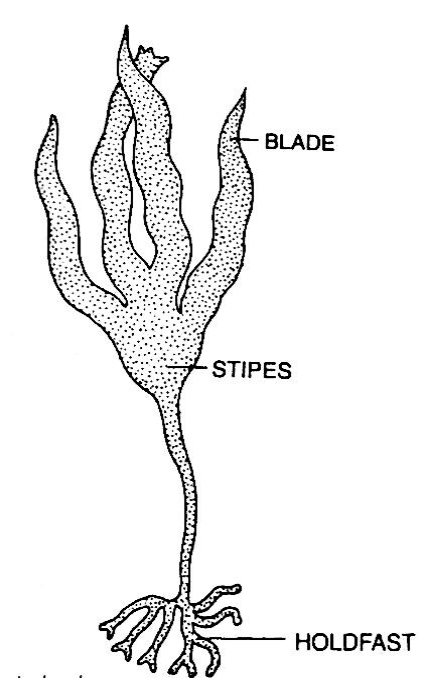
3️⃣ Thallus Organisation (External Morphology)
Large, multicellular brown alga
Thallus is highly differentiated into three parts:
(a) Holdfast
Haptera-like, branched
Strong attachment to rocky substratum
(b) Stipe
Long, flexible, stem-like structure
Supports the blade
(c) Lamina (Blade)
Large, flat, leaf-like structure
Broad surface for photosynthesis
📌 Labelled diagram of Laminaria thallus is very important
4️⃣ Growth Pattern
Growth occurs by intercalary meristem
Meristematic region present between stipe and lamina
Allows continuous growth even if blade is damaged
5️⃣ Internal Structure (Anatomy)
Thallus shows tissue-like differentiation:
(a) Meristoderm
Outermost layer
Protective and photosynthetic
(b) Cortex
Photosynthetic cells
Stores reserve food
(c) Medulla
Central region
Conducting tissue
Contains trumpet hyphae (for conduction)
6️⃣ Cell Structure
Cell wall: cellulose + algin
Pigments:
Chlorophyll a & c
Fucoxanthin (brown colour)
Reserve food:
Laminarin
Mannitol
7️⃣ Nutrition
Autotrophic
Performs photosynthesis
Adapted to low-light marine environment
8️⃣ Reproduction in Laminaria
🔹 A. Vegetative Reproduction
Rare
By fragmentation
🔹 B. Asexual Reproduction
By zoospores
Zoospores are:
Haploid
Biflagellate (one tinsel, one whiplash flag


