
1. Introduction
Marchantia is a thalloid liverwort belonging to Bryophytes. It commonly grows in moist, shady places such as damp soil, rocks, and walls. It is a dioecious plant and is a classic example studied in bryophytes.
2. Systematic Position (Classification)
Kingdom: Plantae
Division: Bryophyta
Class: Hepaticopsida (Marchantiopsida)
Order: Marchantiales
Family: Marchantiaceae
Genus: Marchantia
3. Habitat
Moist and shady places
Damp soil, rocks, river banks
Grows well in rainy season
4. External Morphology (Gametophyte)
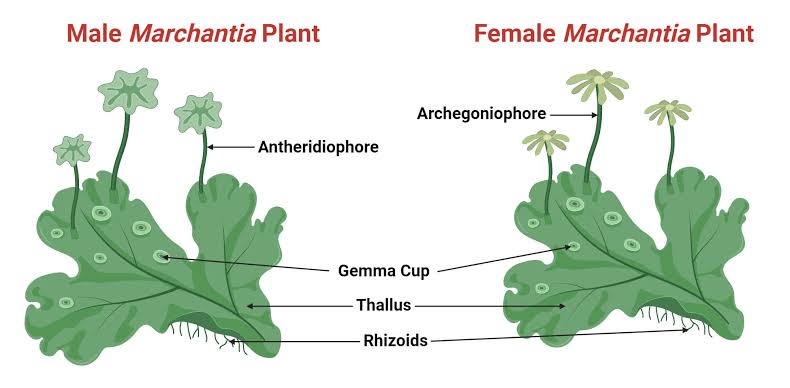
Plant body: Thalloid, dorsiventral, flat and ribbon-like
Colour: Green
Branching: Dichotomous
Upper surface: Shows polygonal markings due to air chambers
Lower surface: Bears scales and rhizoids
5. Internal Structure of Thallus
(a) Upper Epidermis
Contains air pores (barrel-shaped, multicellular)
Helps in gaseous exchange
(b) Air Chambers
Located below upper epidermis
Contain photosynthetic filaments
(c) Storage Tissue
Parenchymatous cells
Stores food material
(d) Lower Epidermis
Bears:
Scales (multicellular)
Rhizoids (unicellular, two types)
6. Rhizoids
Two types:
Smooth rhizoids – for anchorage
Tuberculate rhizoids – help in absorption of water
7. Vegetative Reproduction
(a) Fragmentation
Thallus breaks into pieces
Each fragment grows into new plant
(b) Gemmae Formation
Specialized structures called gemma cups
Gemmae are multicellular, green, discoid
Dispersed by rainwater → grow into new thallus
8. Sexual Reproduction
Marchantia is dioecious (male & female plants separate).
(a) Male Reproductive Organ – Antheridium
Borne on antheridiophore (stalked disc)
Produces biflagellate antherozoids
(b) Female Reproductive Organ – Archegonium
Borne on archegoniophore (umbrella-like structure)
Produces one egg cell
Fertilization
Requires water
Antherozoid swims to archegonium
Fusion of gametes → zygote
9. Sporophyte (Sporogonium)
The sporophyte remains attached to the gametophyte.
Parts of Sporophyte
Foot – absorbs nutrition
Seta – short, stalk-like
Capsule – produces spores
10. Capsule Structure
Contains:
Spores (haploid)
Elaters (elongated cells with spiral thickenings)
Elaters help in spore dispersal
11. Life Cycle
Shows alternation of generations
Gametophyte → dominant, independent
Sporophyte → dependent
12. Importance of Marchantia
Biological Importance
Pioneer plant in ecological succession
Prevents soil erosion
Adds organic matter to soil
Academic Importance
Standard example of liverworts
Studied in bryophyte reproduction


