
1. Systematic Position
Phylum: Arthropoda
Subphylum: Crustacea
Class: Malacostraca
Order: Decapoda
Genus: Penaeus / Palaemon
2. Habit and Habitat
Aquatic, mostly marine (some freshwater).
Bottom-dwelling, active swimmer.
Nocturnal in habit.
Omnivorous and scavenger.
3. External Morphology
Body elongated, bilaterally symmetrical.
Covered by hard chitinous exoskeleton, impregnated with calcium salts.
Body divided into two main regions:
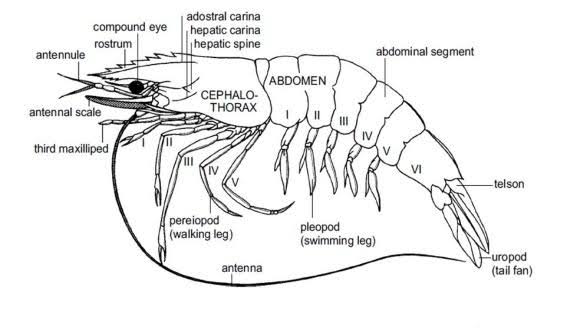
Cephalothorax
Abdomen
4. Cephalothorax
Formed by fusion of head + thorax.
Covered by a large carapace.
Anterior projection called rostrum (toothed).
Compound eyes stalked and movable.
Appendages of Cephalothorax (13 pairs)
Head Appendages (5 pairs)
Antennules – balance & touch
Antennae – sensory
Mandibles – crushing food
First maxillae
Second maxillae
Thoracic Appendages (8 pairs)
6–8. Maxillipedes (3 pairs) – food handling
9–13. Walking legs (5 pairs)
First 3 pairs are chelate (clawed)
Used for walking, feeding, defense
5. Abdomen
Consists of 6 segments + telson.
Each segment bears a pair of pleopods (swimming legs).
Sixth segment + telson + uropods form tail fan.
Used for rapid backward swimming.
6. Exoskeleton & Moulting
Exoskeleton rigid, non-living.
Growth occurs by ecdysis (moulting).
Controlled by ecdysone hormone.
7. Digestive System
Complete and well developed.
Mouth → oesophagus → stomach → intestine → anus.
Stomach (Two Parts)
Cardiac stomach – food storage
Pyloric stomach – filtration
Contains gastric mill with chitinous teeth.
Hepatopancreas (digestive gland) secretes enzymes and absorbs nutrients.
8. Respiratory System
Respiration by gills (phyllobranchiate type).
Gills attached to thoracic appendages.
Water current produced by scaphognathite.
9. Circulatory System
Open type.
Blood = haemolymph.
Dorsal heart with ostia.
Respiratory pigment: haemocyanin (copper-based).
10. Excretory System
Green glands (antennal glands).
Located at base of antennae.
Excretion mainly of ammonia (ammonotelic).
11. Nervous System
Brain (supra-oesophageal ganglion).
Circum-oesophageal connectives.
Double ventral nerve cord with segmental ganglia.
Sense organs:
Compound eyes
Antennules (statocysts for balance)
12. Reproductive System
Sexes separate (dioecious).
Sexual dimorphism present.
Male
Testes in cephalothorax.
Copulatory structures: petasma.
Female
Ovaries large, greenish.
Sperm-receiving structure: thelycum.
Internal fertilization.
Development indirect.
13. Larval Development
Sequence of larval stages:
Nauplius
Protozoea
Mysis
Post-larva
Adult
14. Economic Importance
Useful
Highly nutritious seafood.
Important in fisheries & export.
Source of protein.
Harmful
Rarely harmful; may act as intermediate host for parasites.
15. Adaptive Features
Gills for aquatic respiration.
Tail fan for escape.
Sensory antennae for environment detection.
Camouflage coloration.


