
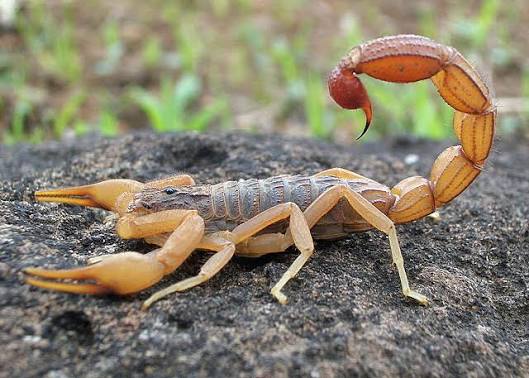
1. Systematic Position
Phylum: Arthropoda
Subphylum: Chelicerata
Class: Arachnida
Order: Scorpiones
Genus: Heterometrus / Palamnaeus
2. Habit and Habitat
Terrestrial, mostly nocturnal.
Found under stones, logs, burrows.
Carnivorous, feeds on insects and small animals.
Shows parental care (young carried on mother’s back).
3. External Morphology
Body elongated, bilaterally symmetrical.
Covered by thick chitinous exoskeleton.
Body divided into three regions:
Prosoma (cephalothorax)
Mesosoma (pre-abdomen)
Metasoma (post-abdomen / tail)
4. Prosoma (Cephalothorax)
Covered by a carapace.
Bears six pairs of appendages:
Appendages
Chelicerae – small, for cutting food
Pedipalps – large, chelate (pincers) for prey capture
3–6. Four pairs of walking legs
Eyes
One pair of median simple eyes
2–5 pairs of lateral simple eyes
5. Mesosoma (Pre-abdomen)
Broad, consists of 7 segments.
Bears:
Genital operculum
Pectines (comb-like sensory organs, unique to scorpions)
Book lung openings
6. Metasoma (Post-abdomen / Tail)
Narrow, segmented (5 segments).
Ends in a telson.
Telson bears:
Venom glands
Curved sting (aculeus)
7. Digestive System
Mouth → pharynx → oesophagus → midgut → hindgut → anus.
Extra-oral digestion present.
Hepatopancreas aids digestion and absorption.
8. Respiratory System
Respiration by 4 pairs of book lungs.
Openings on mesosoma.
9. Circulatory System
Open circulatory system.
Dorsal tubular heart.
Haemolymph usually colourless.
10. Excretory System
Malpighian tubules
Coxal glands
Excretion mainly uric acid / guanine.
11. Nervous System
Brain and ventral nerve cord.
Sense organs:
Simple eyes
Sensory hairs
Pectines (detect vibrations & chemicals)
12. Reproductive System
Sexes separate (dioecious).
Fertilization internal via spermatophore.
Courtship dance common.
Female
Viviparous in many species.
Young born alive.
13. Development
Direct development.
Young resemble adults.
Juveniles climb onto mother’s back after birth.
14. Venom
Venom used for prey capture and defense.
Mostly neurotoxic.
Only few species dangerous to humans.
15. Economic Importance
Useful
Controls insect population.
Venom used in medical research.
Harmful
Sting can be painful or fatal in rare cases.
16. Adaptive Features
Strong pedipalps for grasping prey.
Venomous sting for defense.
Pectines for environmental sensing.
Nocturnal habit reduces predation.


