
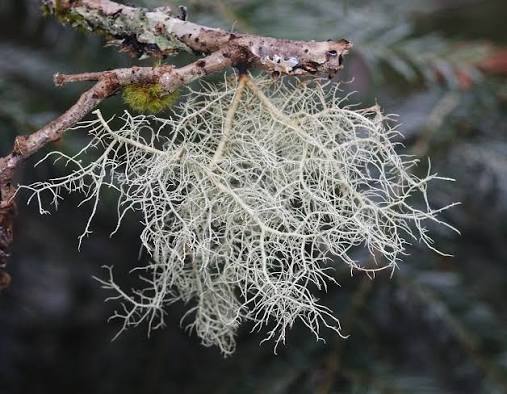
1. Systematic Position (Classification)
Kingdom: Fungi
Division: Ascomycota
Class: Lecanoromycetes
Order: Lecanorales
Family: Parmeliaceae
Genus: Usnea
2. General Introduction
Usnea is a fruticose lichen, commonly known as “old man’s beard” due to its long, hanging, hair-like appearance.
It is an important lichen both ecologically and medicinally.
It is a symbiotic association between:
Mycobiont: Ascomycete fungus
Phycobiont: Green alga (Trebouxia)
3. Habitat
Grows on tree branches and trunks (corticolous)
Common in mountainous, forest, and clean-air regions
Very sensitive to air pollution
4. Thallus Structure
Type: Fruticose
Form: Shrubby, pendulous, hair-like
Colour: Pale green to yellowish-green
Attachment: Fixed to substratum at a single basal point
Special Feature
Presence of a central elastic axis (solid fungal core), a key identifying character
Internal Structure
Cortex
Compact fungal hyphae
Protective layer
Algal Layer
Green algal cells (Trebouxia)
Photosynthetic zone
Medulla
Loosely arranged fungal hyphae
Central Axis
Dense fungal hyphae
Provides strength and flexibility
5. Reproduction
A. Vegetative Reproduction
Fragmentation
Soredia (very common)
B. Asexual Reproduction
By conidia (rare)
C. Sexual Reproduction
Occurs through the fungal partner
Fruiting body is apothecium
Apothecium
Disc-shaped, lateral
Yellowish or brown
Asci
Produce 8 ascospores
6. Nutrition
Algal partner: Photosynthesis
Fungal partner: Absorbs water, minerals, and provides protection
Association is mutualistic
7. Economic Importance
Source of usnic acid (antibiotic, antifungal)
Used in traditional medicine
Indicator of clean air quality
8. Ecological Importance
Important in nutrient cycling
Provides nesting material for birds
Pioneer species in forest ecosystems
9. Diagnostic Features (Exam-Oriented)
Fruticose lichen
Pendulous thallus
Central elastic axis present
Algal partner → Trebouxia
Sensitive to air pollution


